Congratulations to Maggie and Marcus, two of our HKU Landscape BA(LS) graduates who won the Prize for Outstanding Water Sustainability Undergraduate Capstone Project awarded by HKU’s Water Centre for their final-year studio projects.
Project: “Embedding landscape in riverine reserve design: Ecological metrics and manageability to strengthen unplanned community-based conservation networks in northern Thailand”
Marcus Leung Lok Yin proposes a landscape planning framework for increasing the sustainability and resiliency of one of Southeast Asia’s largest networks of community-based fish conservation zones. The roughly 50 existing zones were established and managed by the majority ethnic Karen villagers in Thailand’s Mae Hong Son Province over the past three decades. Existing freshwater ecology research on this network suggests it had a net positive effect on fish sustainability but that overfishing pressures continue to have adverse ecological impacts. Marcus’s framework challenges and extends a previous ecological assessment of this network by considering several additional landscape metrics for gauging the suitability and capacity of individual communities to fill gaps in the conservation network with additional zones. Karen people are deeply attached to the water, and these fish conservation zones provide a wide range of community benefits, including food security (fish is their primary protein source) and cultural sustainability. Marcus uses his landscape architecture and planning skillsets to accomplish the difficult task of simultaneously considering traditional ecological knowledge, science on freshwater ecology, and the political-economic legacies of Southeast Asia’s highland communities.
Project: “Field operations on hydrosocial territories: Landscape impacts of reservoir construction on the lower Yuam River, Thailand”
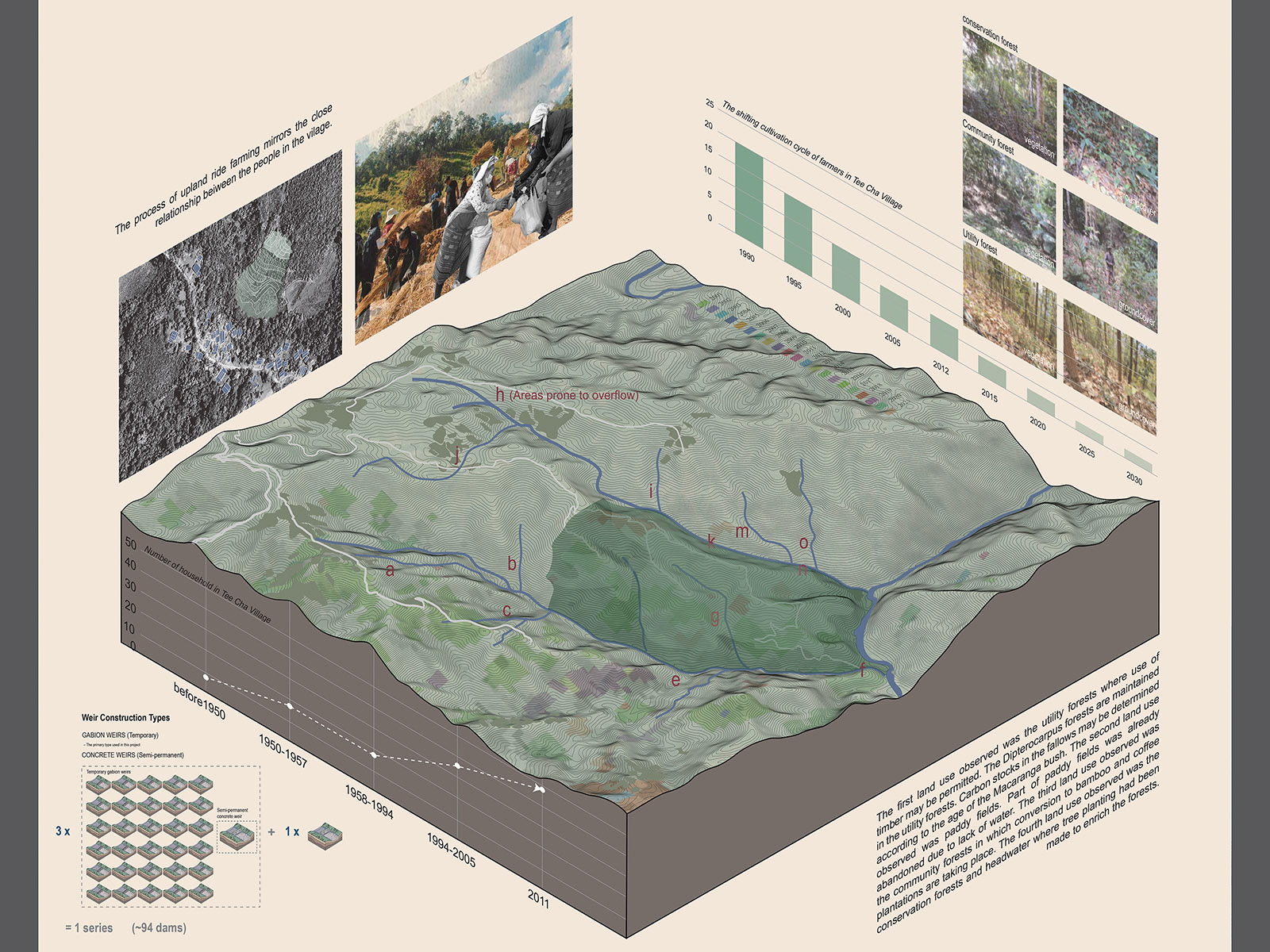
Maggie Yao Renyue proposes a series of strategies for the majority ethnic Karen communities living along the diversion tunnel’s planned 20-kilometer-long reservoir in Thailand’s Mae Hong Son Province. The diversion tunnel requires over one thousand check dams (weirs) to be constructed within the immediate catchments surrounding the reservoir to regulate water flow and sediment. Maggie first interrogates the planning and construction process of this highly dispersed system of weirs and considers their potential impacts on both the freshwater ecology and communities’ agricultural livelihoods. She then proposes (1) repurposing these weirs to maximize benefits to both agriculture and local ecology, and (2) taking advantage of nascent ecotourism opportunities. Maggie’s project has numerous compelling strengths, including her investigation of past legacies of development in the project area, consideration of cross-sector impacts beyond the status quo assessment, focus on community livelihood and cultural sustainability, scenario-building to deal with the uncertainty of large-scale development, and incorporating tactical landscape architecture and civil engineering interventions into larger-scale planning.



Posted by: Ashley Scott Kelly (Design for Conservation)